
Preview build. Not indexed, not public. Content pending legal review.
Skip to the facility questionnaire
SHEET 01THESIS

For cannabis and botanical processing labs

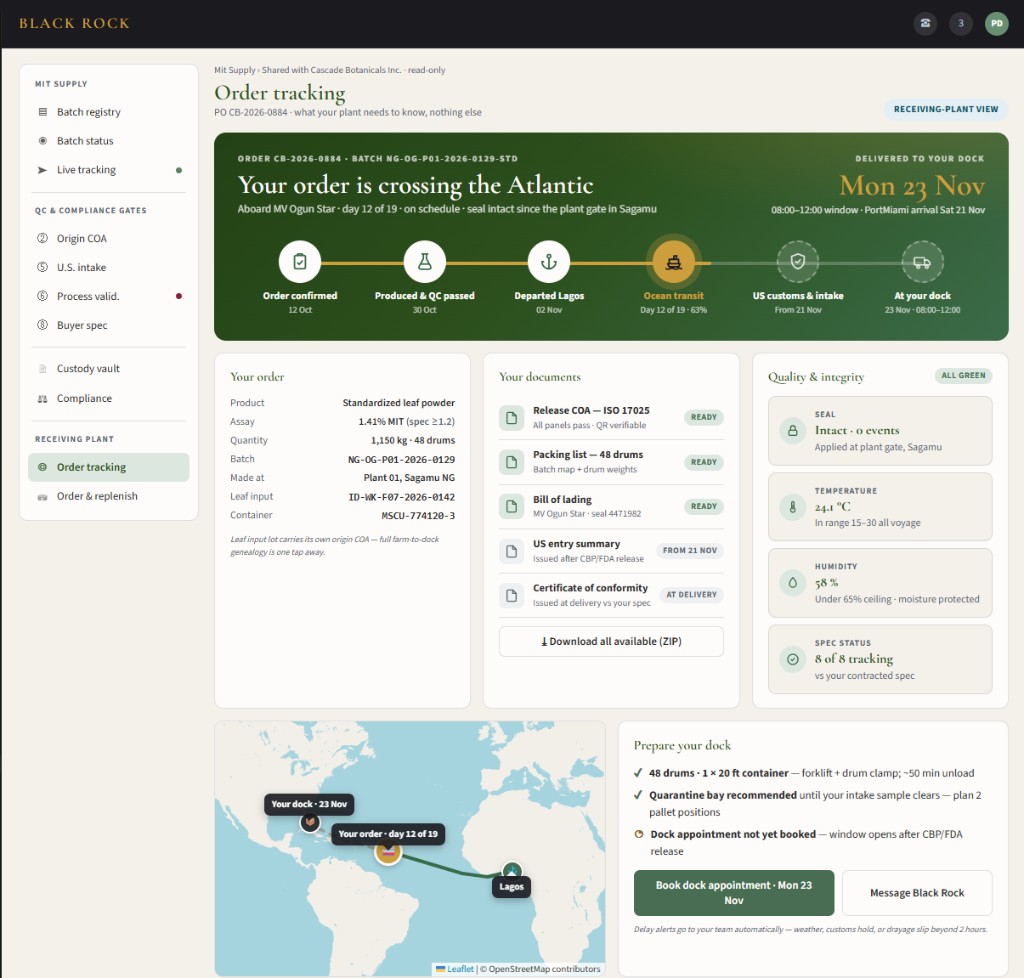
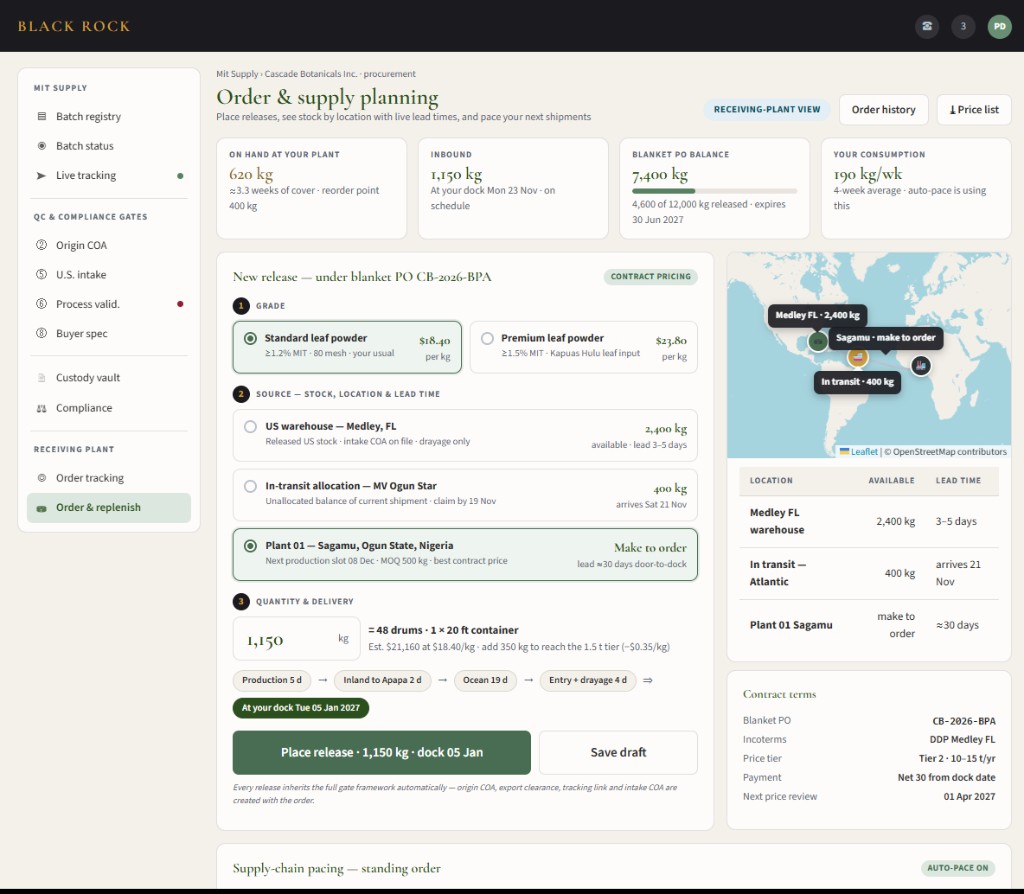
We bring botanical kratom from Southeast Asian farms to your dock, and help you convert your existing lines to process it.

One lane of this market is closing. Your building may already be most of the way into the other one.

A federal action filed in July is set to restrict concentrated and synthetic formulations. It does not reach traditional botanical material that stays below the threshold — which makes compliant botanical processing the durable side of the line.

Most cannabis dry-milling lines are closer to that work than their operators assume. The gaps are specific, and they are namable. This page exists to tell you which ones are yours.

SHEET 02AT A GLANCE

Where the supply chain stands

Four figures, as they are today. The limits attached to them are further down this page, and they are the reason to believe the rest.

Containers cleared in 2025
In port today
In port today
Contracted monthly capacity
Family-owned farms, and growing

A track record, not a guarantee. Import Alert 54-15 remains in force and applies to kratom entries regardless of any prior clearance history. No one can promise you an entry will clear.

SHEET 03FACILITY QUESTIONNAIRE

What can your building actually do

Seven questions, about two minutes. The first two redraw the map above. You get a written read on your facility at the end whether or not you ever speak to us.

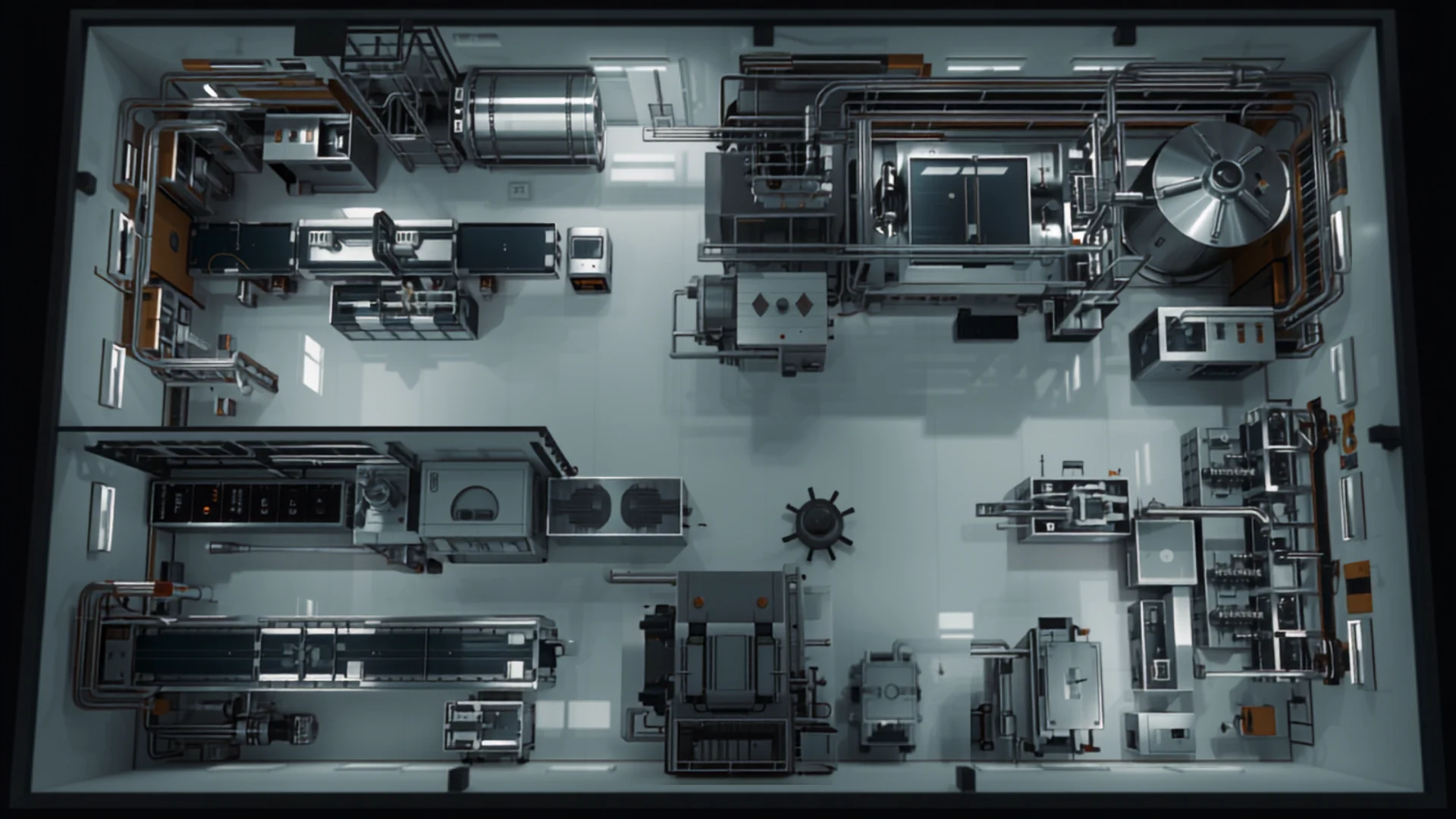
PLAN VIEW — POWDER LINEGENERIC
Facility conversion plan viewGeneric plan view of a processing facility. Answering the first two questions of the facility questionnaire redraws this to your building.
LEGEND
  • Reuses for kratom
  • Needs retrofit
  • Net-new
  • Not applicable

Answer the first two questions and this drawing redraws to your building.

REV 01/07
  1. Step 1, current
  2. Step 2
  3. Step 3
  4. Step 4
  5. Step 5
  6. Step 6
  7. Step 7
What do you run today?

Kill step

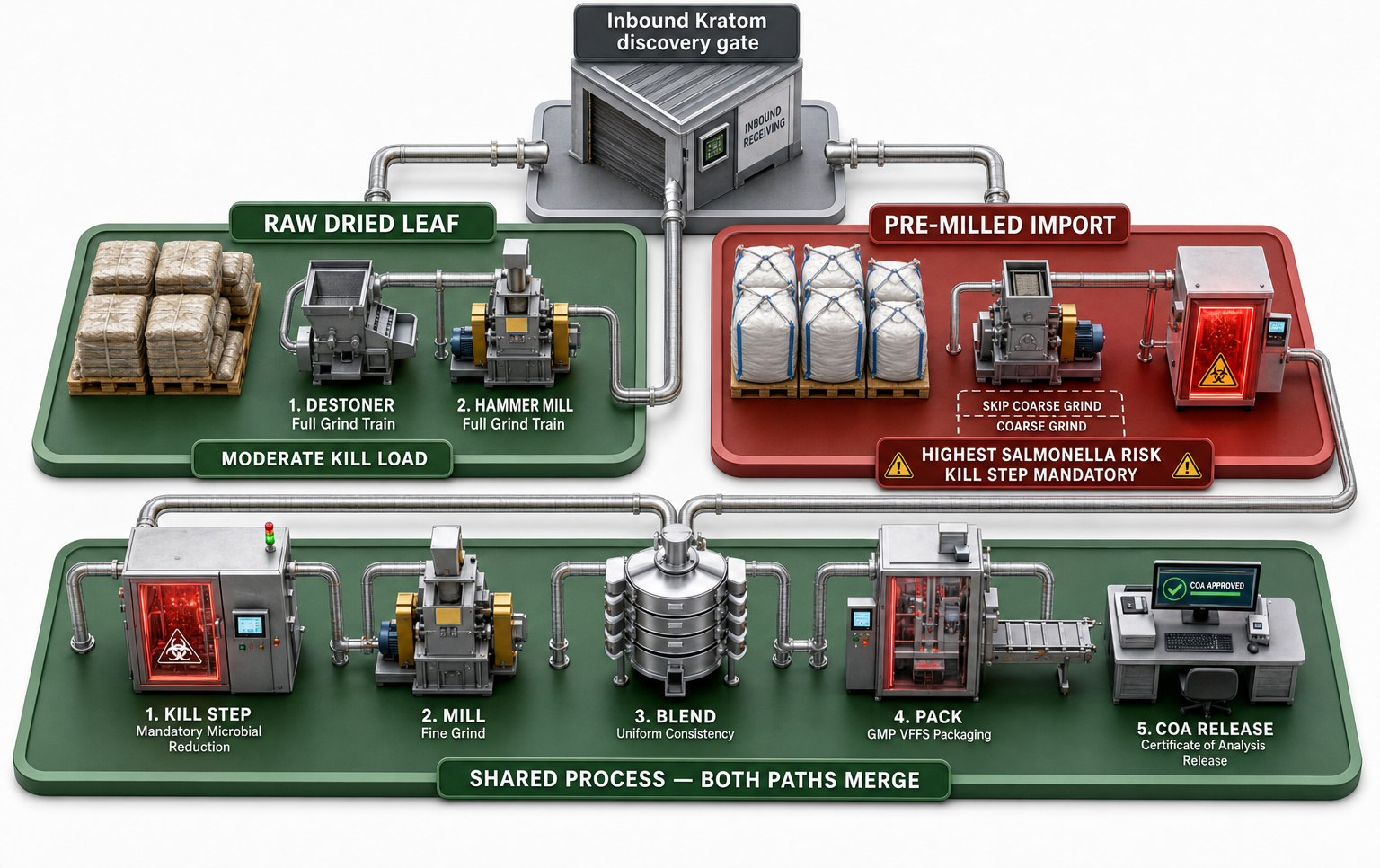
Heat treatment for microbial reduction. This is net-new for essentially every cannabis facility, because cannabis processing has no equivalent step. It is the single most common gap, and the one most likely to be missing from a conversion budget.

Inbound material

Inbound material affects this drawing. Raw dried leaf needs the full grind train and carries a longer quarantine; pre-milled material skips coarse grinding but places more load on the kill step. Worth settling before you size the line.

SHEET 04REGULATORY BRIEFING

What changed

This is a summary of a filing, written for an operator deciding where to put capital. It is not a recommendation and it is not legal advice.

  1. 1 July 2026

    Notices of Intent filed

  2. 6 July 2026

    Published in the Federal Register

  3. 5 August 2026Not yet

    Order expected, effective the day it publishes

  4. two years, with a possible one-year extensionNot yet

    Term, if it takes effect

What was filed

Two Notices of Intent went to the Federal Register on 1 July 2026, published 6 July 2026.

Each proposes temporary placement in Schedule I.

The orders are expected on or after 5 August 2026, taking effect on the date they publish, and would run two years, with a possible one-year extension.

As of this writing the orders have not yet published.

What it covers

The first notice reaches 7-OH above a specified threshold: 0.05% for the plant.

For material further processed into extracts, concentrates, edibles or pressed pills, the threshold is 0.05%, or 1 mg per article.

A second notice addresses three related substances.

The threshold itself is open for public comment under a separate request for information, and could move.

What it does not cover

The action is directed at concentrated and synthetic formulations.

Traditional botanical material whose naturally occurring 7-OH sits below the threshold is not within its scope.

That is the distinction the rest of this page is built on. It is a threshold question, decided lot by lot on assay — not a category exemption.

Nothing on this page places any material outside the reach of the action. Assay results and your own counsel decide that.

Regulatory summary only. Not legal advice. Confirm current status with your own counsel.

SHEET 05IMPLICATION

What it means for your facility

01

Displaced demand has to land somewhere

A category of enhanced-alkaloid product lines is being restricted. The buyers those lines served do not disappear on the effective date. Demand moves to whatever is still compliant, and compliant botanical powder is the nearest substitute.

02

Compliant supply is the durable position

Anything positioned above the threshold carries scheduling exposure. Material specified and assayed to sit below it does not carry that particular exposure — which is why the specification, not the relationship, is what a serious buyer will ask you about first.

03

The state map is workable, and it is not uniform

Kratom is legal in 41 states at state level, and 14 states have passed Kratom Consumer Protection Acts imposing testing, labelling and 7-OH caps. That is a more developed regulatory framework than the category is usually credited with.

Count excludes nine states with outright bans. The District of Columbia also prohibits it, and California operates a de facto commercial prohibition through administrative action rather than statute. Verify your own distribution footprint with counsel.

04

The category is not yet saturated

Cannabis processing capacity outran cannabis demand, which is the compression most of this audience is living through. Botanical kratom has not been through that cycle. Capacity and first-position contracts are being allocated now, by operators who move early — but the reason to move is fit, not timing.

Regulatory summary only. Not legal advice. Confirm current status with your own counsel.

SHEET 06CLASSIFICATION

Classify your lab

Three facility types. One answer — do you run dry milling, extraction, or both — drives reuse, cost and timeline more than anything else about your building.

Flour / dry-milling line

Best conversion target

Equipment reuse
~60–70%
Total conversion cost
~$715k
range $355k–$1.34M
Timeline
10–14 weeks

NET-NEW FOR YOU

  • Kill step
  • Dust and HVAC capacity
  • Quality management system
  • COA panel coverage

Your mills, sieves, blending and pack lines carry over. The quality system is the part most operators underestimate.

Extraction only

Sounds ready. Is not.

Mill train
Net-new, $90k–$200k
Total conversion cost
$445k–$1.54M
Timeline
12–16 weeks

NET-NEW FOR YOU

  • Full mill train
  • Kill step
  • Dust and HVAC capacity
  • Quality management system

Extraction-only labs often read as the closest fit and are usually the furthest. There is no milling to reuse, so the powder line is built from nothing. Your QA bench space and skid capacity do carry over.

Hybrid — both

Best reuse story

Sequence
Flour line first
Total conversion cost
~$715k–$850k
range $355k–$1.37M
Timeline
10–14 weeks

NET-NEW FOR YOU

  • Kill step
  • Segregation, if you run concurrently

Build the flour line first and run powder while the extraction stack stays on its existing work.

Total conversion cost, including three months of downtime at $50k/month. Ranges are low/mid/high across comparable facilities; the headline figure is the midpoint, not a quote.

Scenario A — full pivot

Shut down, decontaminate, retrofit, validate, restart on kratom only. This is the base case behind every figure above, and it assumes three months of downtime at $50k/month.

Scenario B — concurrent

Keep cannabis running alongside kratom. This requires physical segregation — wall, airlock, duplicate air handling, $100k–$500k — plus either a duplicate mill or a validated cleanout, $40k–$150k. It is rarely viable without separate bays.

Indicative ranges based on comparable facility conversions. Not a quote. Actual scope depends on a site walkdown.

SHEET 07FRAMEWORK

Leaf to Label

Five stages. Most brokers stop after the second one.

  1. 01

    Source

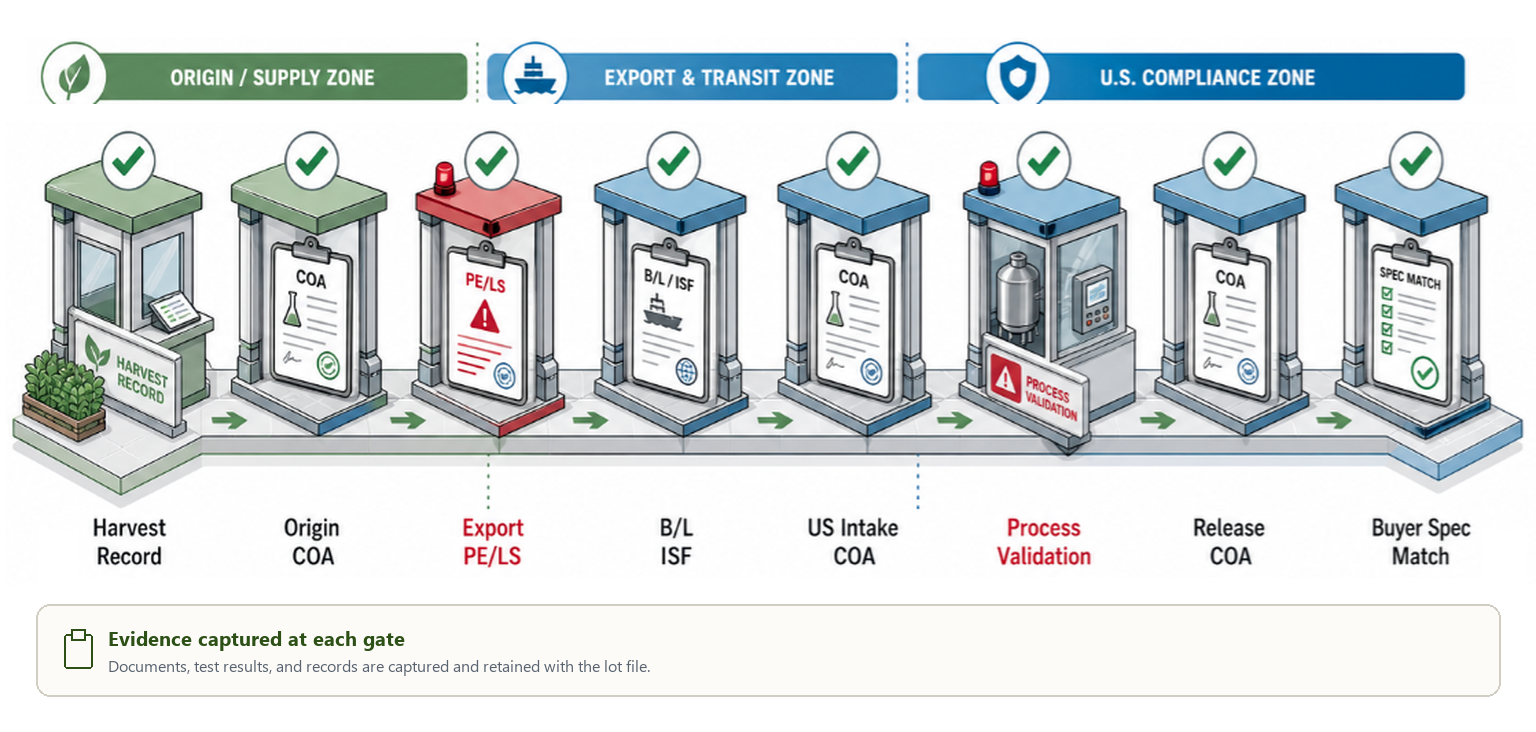
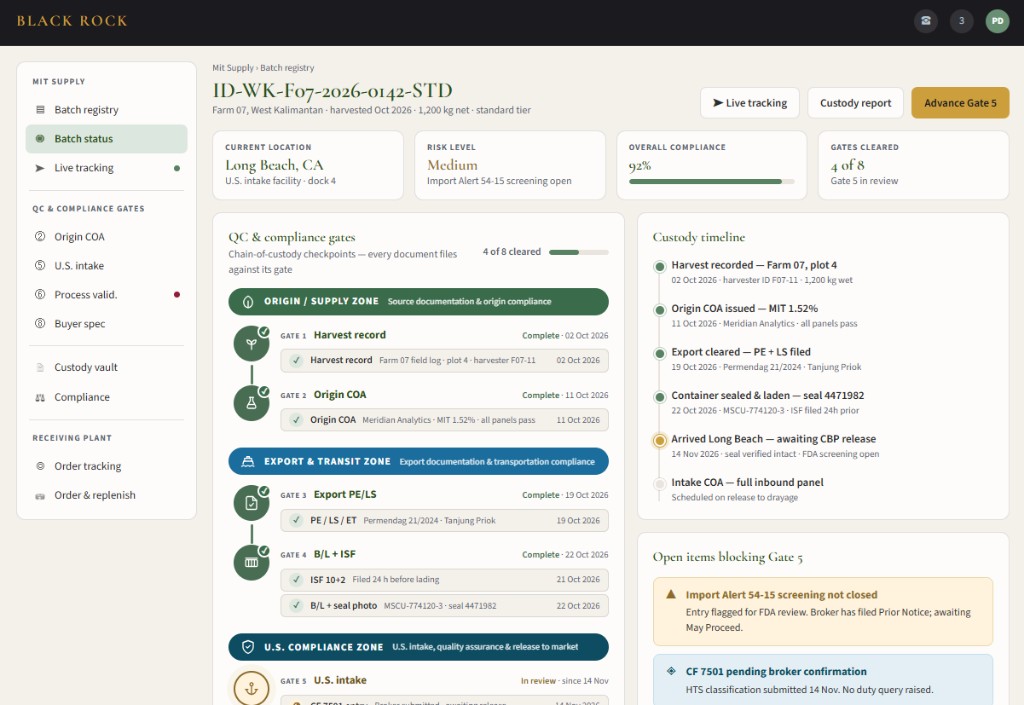
    Farm relationships in West Kalimantan / Kapuas Hulu, with documentation per shipment.

  2. 02

    Ship

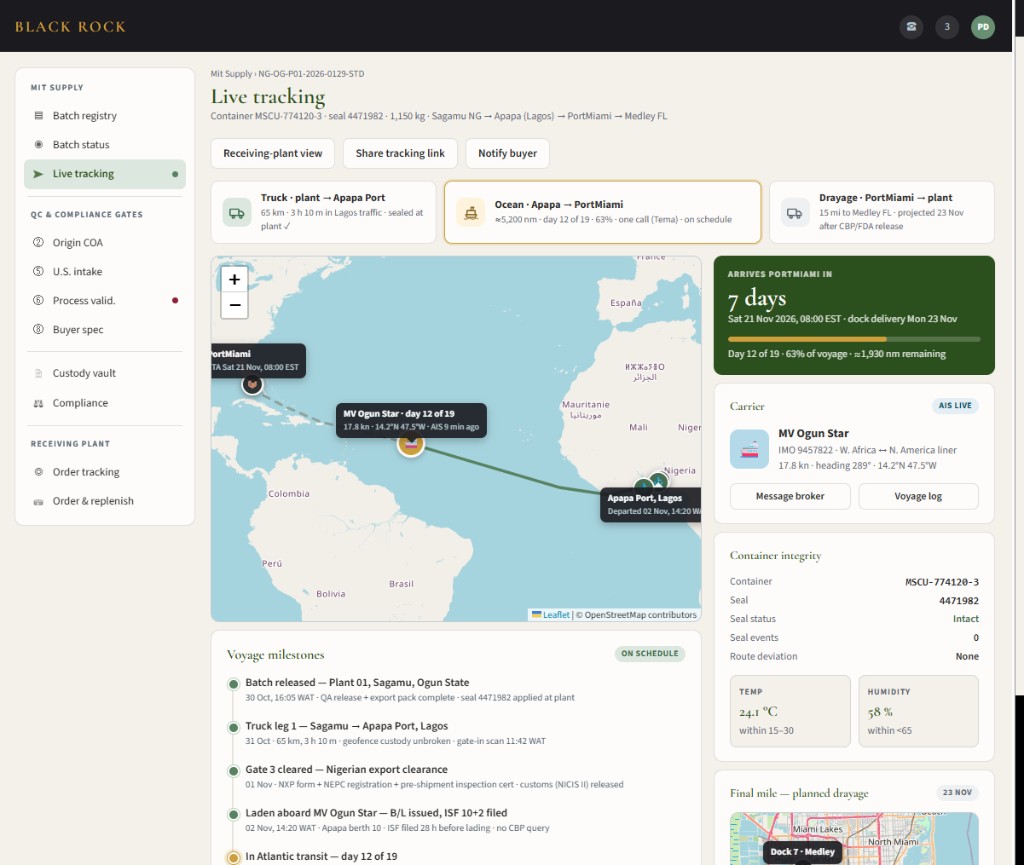
    Export paperwork, customs, tariffs and freight to your dock.

  3. 03

    Convert

    Conversion planning against your existing equipment, not a generic line.

  4. 04

    Qualify

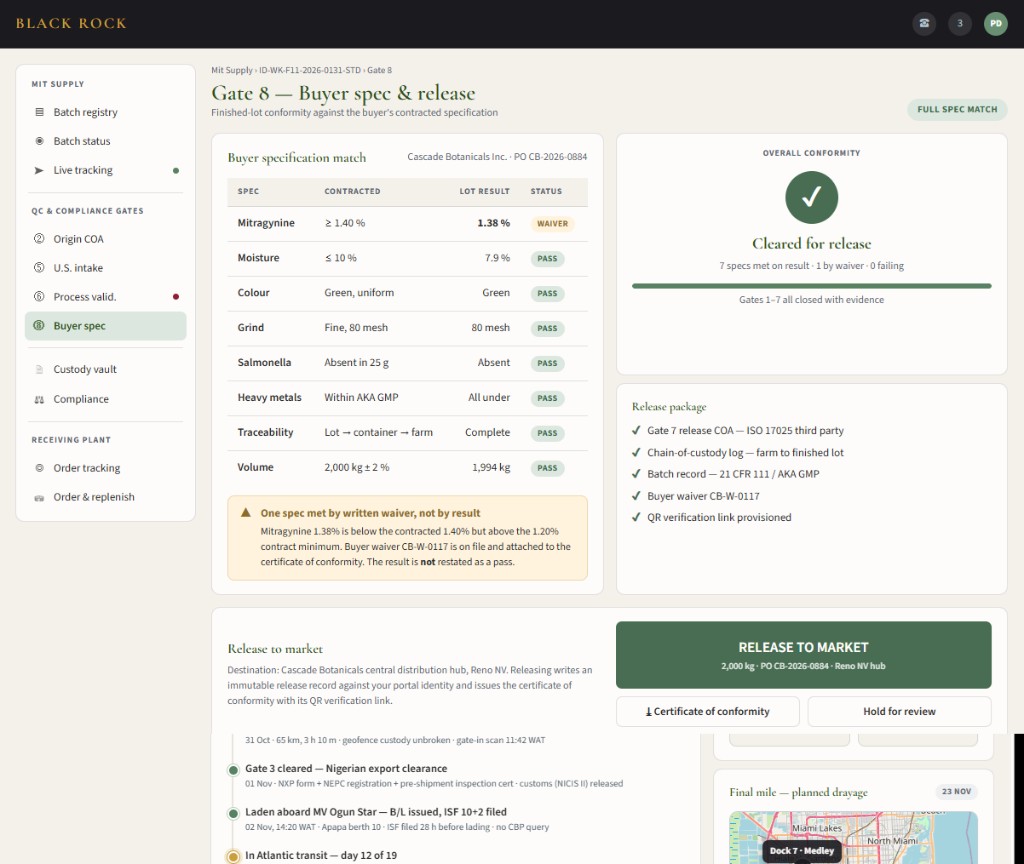
    Specification, COA panel and SOP support through validation.

  5. 05

    Label

    Optional add-on

    Introductions to buyers for finished product.

The first four stages are the engagement. Buyer introductions are offered separately, if and when you want them — your customer relationships stay yours either way.

A broker sells you material and hands you a bill of lading. The difficulty is not landing a container — it is what your building has to become before that container is worth anything to you. The last three stages are where that gets decided, and they are the ones nobody else stays for.

SHEET 08DIVISION

What stays yours

The five stages above are what we carry. Everything below stays where it is, and none of it is negotiable on our side.

  • Your facility

    We do not take an equity position in it and we do not operate it.

  • Your licence

    It stays in your name. We hold nothing that your operation depends on.

  • Your team

    We support your people through validation. We do not replace them.

  • Your customer relationships

    We do not sit between you and the people who buy from you.

  • Your processing margin

    You keep the spread between landed material and finished product.

If any of that is not what you want, the arrangement is the wrong shape and worth saying so early.

SHEET 09SPECIFICATION

What the material is

The specification your buyers will ask you about, with the limits attached. The limits are the reason to believe the figures.

Alkaloid and moisture

1.2% minimum
Mitragynine, contract minimum

Mitragynine, not 7-OH. These are different analytes and the two numbers are not comparable — do not read this figure against the scheduling threshold.

1.4% target
Mitragynine, target
≤12%
Moisture
120–150 kg
Mitragynine per forty-foot container

Total recoverable yield per container, not any single party's share. Under a 50/50 tolling split each side sees roughly half that. Define the split basis in the contract before you model it.

Provenance and documentation

West Kalimantan / Kapuas Hulu
Origin
Permendag 20/2024 and 21/2024
Indonesian export regime

Indonesian export operates under Permendag 20/2024 and 21/2024, which requires registered exporter, export approval and surveyor report documentation per shipment.

Premium dry-season lots test 1.4–1.8% mitragynine. That is a subset of lots, not a container-level expectation, and it is not what the contract commits to.

Regulatory summary only. Not legal advice. Confirm current status with your own counsel.